Search This Blog

Showing posts with label Research Point. Show all posts

12/15/11

Research Point - David, Ingres, Degas, Picasso, Giacometti, Hockney

Jacques Louis David (1748-1825)
Studies after Michaelangelo
David filled his sketchbooks after antique and baroque art but
rejected the rococo tradition. He described contours meticulously.

‘Marie Antoinette on Her Way to the Guillotine’ 16 Oct 1793, pen and ink.
‘Studies after Pietro da Cortona’
black chalk. This is from a fresco
 ‘The Assumption of the Virgin’. 
As an official artist of the French Revolution he sketched victims on their way to the guillotine. This is a very simple looking line sketch, almost a caricature, of Marie Antoinette on her way to the guillotine showing economical and deft use of lines. It encapsulates very well the broken yet dignified expression on her face.


Ingres
Ingres style was Neoclassicism (classical antiquity) and he was the last of the neoclassicist painters – a master of realism.
He was a pupil of David’s.
Ingres lines are very smooth and pure giving his figures a look of flowing elegance. He paid a lot of attention to detail. Infact the stress on line was an important part of his style – delicate but firm.
Portrait of Charles Francois Mallet. Front lighting used here (as in most of Ingres’ drawings) emphasizes the edges. In doing this he followed very much Raphael’s example. In places he has used minimal of broken line to show the saturation of light and bolder on the other side to show the form turned away.

Link to Ingres Miraculous Lines – describes in fascinating detail Ingres career, inspiration and techniques.

Edgar Degas
Woman drying herself after bathing, pastel
Degas was a great admirer of Ingres, whose masterful draughtsmanship was passed on through Degas’ tutor, who was a pupil of Ingres. Yet he also admired the turbulent style of Delacroix. He used a quite linear style in many of his drawings and often reasserted the outlines. The lines of the faces are usually quite controlled, yet the arms or legs for instance, are done in a quick sketchy looking way with numerous restatements. He often used scribbly lines for backgrounds but more controlled parallel hatching strokes for the forms and surface planes of his figures.
One of Degas main concerns was how to convey movement – drawing his subjects from unexpected and unusual angles. This link describes in detail his pre-occupation with movement, particularly in relation to dancers in the ballet.

Pablo Ruiz Picasso
La Sieste (Les Moissoneurs)
La Sieste (Les Moissoneurs), 1919, pencil
Here very fluid curving lines have been used, with little variation in weight, delicately reasserted here and there. This and the soft, voluptuous lines of the contours give form to the two figures.
In contrast Louis Freund’s drawing Pieta, 1960, oil on board,  the lines are wild and frenzied. The contours come and go and singular lines move from one end of the composition to the other in a vigorous exploration.
Louis Freund - Pieta

In Desuudo de espaldas, 1958 (right) Picasso has created a wonderfully expressive drawing with just a few lines.


                                     Alberto Giacometti
Many of Giacometti’s drawings are made up of a mass of often entangled lines, like lengths of wire. This was how he brought about the sitter’s likeness and presence. The turmoil in these  lines appears to give his figures a look of ghostly vulnerability.


David Hockney
Two Dogs – these are two contented looking daschund dogs, delicately rounded and plump. Hockney uses a balance of thin and thicker lines, suggesting just a slight amount of subtle shadow. This seems to anchor them very comfortably in the chair.

Celia Sleeping 1972 – just a minimal amount well placed lines here, which appear to capture the scene perfectly.
In ‘Portrait of Dwight’1979, pen and black ink, Hockney uses multiple short singular and v-shaped directional lines and marks to describe texture in the hair. Loose minimal slightly curving parallel lines describe the ribbing on the sleeve at lower left. There is just an 
Celia sleeping
indication of texture in the closer fibres on the front of the t-shirt
 where the marks are denser and more random.


8/15/11

STRUCTURE - Research Point

Anatomy
Very often when a figure is wrong it easy to see without always knowing exactly what it is. That’s why it is important to have an idea of what is going on deep down under the surface of the skin to appreciate what’s happening close the surface.
On the skeleton there are places where the bones are very near to the overlying skin and these places are visible on most people, even those very overweight. Apart from many points on the head such as the forehead, cheekbones and chin, elsewhere there is also the wrist and anklebones amongst others. These areas are seen as depressions between the main muscle masses and sometimes as projections on thin people.
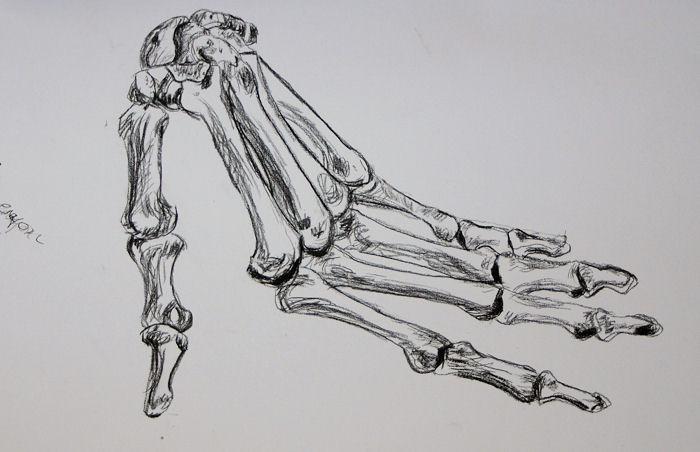
Bones of the hand -conte crayon
Although each person’s body shape is unique, all human bodies work in a similar way. The muscles and their connections are made up of a contracting and expanding system of pulleys, shock absorbers and self lubricating hinges. They are interdependent with the skeleton and without bones, the muscles would not hold together. Muscles connect two different bones, passing over one or more joints. An example is the calf muscle where its origin is on the upper leg bone and its insertion on the heel bone. It pulls the heel up and toes down when it contracts. This gives forward propulsion to the body when walking. The pelvis and buttock muscle (gluteus maximus) are the primary support for the backbone and are most important in establishing the balance of the figure. The legs have very mobile joints with the pelvis and support the weight of the rest of the body. This is the major difference between humans and animals.
My own version
In drawing the body being able to recognize the main muscle groups is very helpful in selecting which forms are the most significant. It helps in placement of lines (lines between  functions) at meeting points even though they are not visible on the figure.

After Andreas Vesaluiua De Humani Corporis Fabrica, 1543, New York Academy of Medicine from Drawing Lessons from theGreat Masters by Robert Beverly-Hale.
I knew from looking at this drawing that it is very complex. I didn’t intend to copy the whole figure at one go and soon after I started I began to realize just how complicated it is. 
 There are many muscles clustered around the top of the lower arm but each one can be broken down into just three groups: the supinator – rotates the hand, flexor - flexes and extensor – extends. The muscles in the hamstrings are also grouped in a similar way. The undulating lines both for the outlines and for those of the muscles really give a strong sense of movement.  My own version certainly doesn’t live up to this description.

Anatomy Sketch – from John Raynes Book
I found this drawing more enjoyable than the previous one. Some of the shapes and angles were inaccurate in on my first attempt, so I adjusted these. The most interesting part was doing the sketchy lines heading in multiple directions and the way they flowed into one another.

On comparing this drawing with the life drawing I did of the standing pose (one of the 3 Drawings exercises) it was easier to imagine much of the underlying muscle structure. I also noted how the hands in the illustration I referred to are drawn with a real feel for the underlying skeleton. When copying them I found it was easier to convey lifelike hands than previously. I hope this trend will continue unabated, but I'm not holding my breath. However, drawing the subject rather than just looking at the anatomical drawings, really seemed to help me to absorb the information more easily. 


Anatomy sketch                           Book illustration


Rodin’s Seated Nude
This to me is a good example of how  flowing and undulating outlines make out the rounded forms as in that of the ribcage, the shapes of the major muscles and where the bones are close to the underlying skin.